

Learn about Treaty
Allyship is about educating yourself and those around you, so everyone who calls Victoria home can learn about and be part of the Treaty journey…
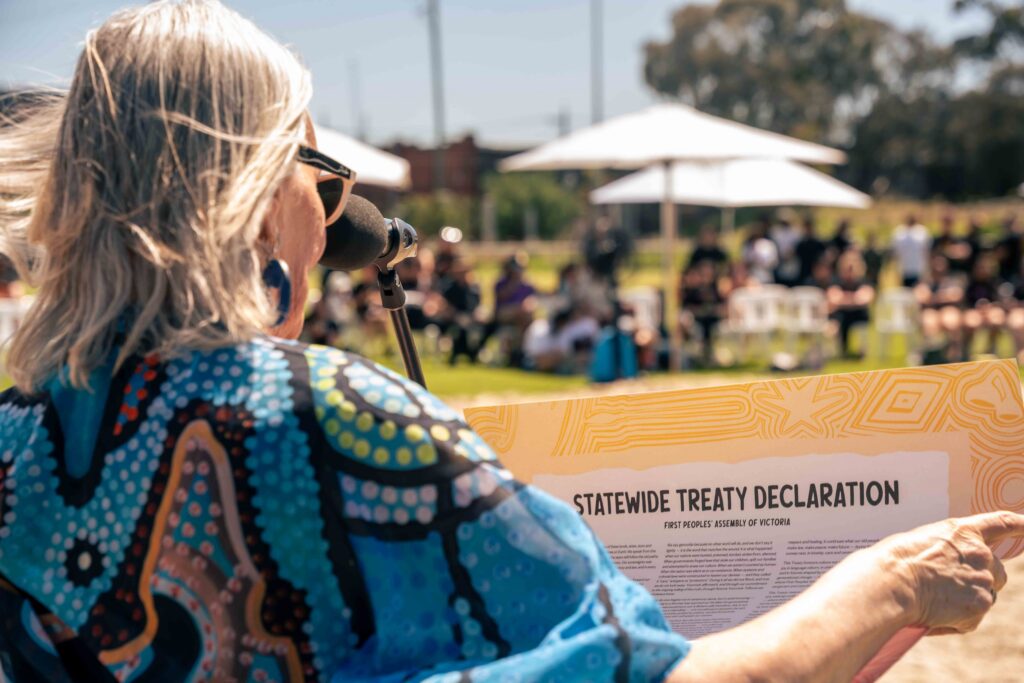
Last year, Australia’s first Treaty was signed and became law, here’s what you need to know…
A Treaty is an agreement that sets out ground-rules and agreements for a relationship between different groups. In this case – the Victorian Government and the First Peoples’ Assembly of Victoria.
Many countries have Treaties between the Government and First Peoples, as a way of ensuring First Peoples can make decisions about their communities.
Treaty allows First Peoples to have a seat at the table and negotiate what is best for our communities.
Treaties will acknowledge the truth about what was done to Aboriginal people and make sure Aboriginal communities always have the freedom and power to come up with and deliver practical solutions at a local level.
Treaty resets the relationship between First Peoples and the State because doing things differently is the only way to achieve real change. It goes beyond symbols and empty promises to set up structures to allow for self-government: putting decision-making back in our hands.
People thrive when they can set their own course in life and can make choices about what works best for them and their families based on their own needs, experiences, talents and aspirations.
Treaty recognises that when it comes to Aboriginal communities, cultures and lands, the experts are of course Aboriginal people. The more this fact is respected and we can make decisions about things that impact us, the more our communities will thrive.
Treaty also allows Victoria as a state to acknowledge and reckon with the truth of what was done to Aboriginal people so we can all get on with creating a better future together.
Up until last year, Australia was one of the only commonwealth countries without a Treaty with First Peoples. Last year, we righted this wrong.
Since December 2025, Treaty has been law in Victoria.
But the journey started long before that…
The advocacy and resilience of mob since invasion lay the groundwork for the first official call for a Treaty at the National Aboriginal Conference in 1979.
In 1988 Prime Minister Bob Hawke committed to Treaty by 1990 , but that promise was broken and the government commenced a decade of statutory Reconciliation instead.
In 2016, First Peoples renewed their call on the Victorian government to advance Treaty. The Victorian government at that time committed to starting that work. The Treaty Working Group was established, which led to the establishment of the Treaty Advancement Commission. Aunty Jill Gallagher AO was appointed the Commissioner. She was incredibly generous in her time yarning and consulting with both community and allies about Treaty.
In 2019, Parliament passed the Aboriginal Victorians Act 2018 (Treaty Act) which lay the groundwork for Treaty. This is when the first set of members, all Traditional Owners of Country in Victoria, were elected by their communities as the First Peoples Assembly of Victoria.
In 2023, the second set of First Peoples’ Assembly Members were elected by their communities. It was during this term that treaty was negotiated between the First Peoples’ Assembly of Victoria and the Victorian Government.
In April 2026, the third term of the Assembly was elected, whose job it will be to implement the promises made in the first Statewide Treaty, and work with First Nations communities to deliver Treaty.
Statewide Treaty covers statewide matters that impact all First Peoples living in Victoria, such as improving health, education and justice.
This is different from local Traditional Owner Treaties which reflect Traditional Owners’ aspirations and priorities for their own Country.
- First Peoples’ Institute: The first Statewide Treaty also focused on building knowledge, skills and leadership by creating a First Peoples’ Institute.
- Truth-telling in the curriculum: It included Truth-telling in schools through Victorian Curriculum because for generations, many Victorians were not given the ability to access or reckon with our past, but now the Victorian school curriculum will help future generations understand our history and why we need Treaty.
- First Peoples’ Place Names: The first Statewide Treaty also including processes for First Peoples’ naming of geographical features, including increasing opportunities for use of traditional and language place names.
- Under Treaty, First Peoples will lead statewide awards and events that honour First Peoples’ contributions across Victoria.
- First Peoples’ Infrastructure Fund: From 2027, Gellung Warl will establish and operate a new First Peoples’ Infrastructure Fund, working with community to reimagine how self-determined investment in First Nations community infrastructure and infrastructure development can be achieved through the Fund.
- Ceremonial Markers: Gellung Warl and the State will create physical and other recognition of Victoria as a Treaty State, including involving Gellung Warl in the ceremonial life of the State.
- Culturally capable workforce: the State will take certain actions to develop a culturally capable public sector workforce.
A main part of the first Statewide Treaty is making the First Peoples’ Assembly permanent as a democratically elected representative body for Traditional Owners of Country and First Peoples in Victoria.
Under Treaty, the First Peoples’ Assembly became part of Gellung Warl, meaning ‘tip of the spear’ in Gunaikurnai language.
How to pronounce it: Gullungwarl
(‘g’ as in ‘good’, ‘u’ as in ‘put’)
Gellung Warl will be comprised of The First Peoples’ Assembly of Victoria, Nyerna Yoorrook Telkuna and Nginma Ngainga Wara.
The Assembly will be responsible for making decisions in Gellung Warl, including appointing members to the two new bodies.
The First Peoples’ Assembly is the elected body under Gellung Warl – made up of 34 Traditional Owners of Country in Victoria, voted in by our communities.
Some are elected by their Traditional Owner group, others are elected by community members in the geographic region we represent.
We meet throughout the year to make key decisions and represent the voices of our communities.
We also look to the our Elders’ Voice and Youth Voice to ensure that mob of all ages are informing the journey to Treaty.
To ensure the voices of all First Peoples in Victoria are heard, the Assembly seeks out the views and expertise of Aboriginal Community Controlled Organisations and Aboriginal Trusts, all Traditional Owner groups, as well as First Peoples who are not Victorian Traditional Owners.
Nyerna Yoorrook Telkuna meaning “To sit, to listen to hear, to remember truth, to cure, to heal” in the Wamba Wamba/Wemba Wemba language is an ongoing truth-telling arm.
It will continue the work of the Yoorrook Commission’s first formal truth-telling inquiry into historic and ongoing systemic injustices perpetrated against First Peoples through colonisation, led by First Peoples.
How to pronounce it: Nyern-ah Yoo-rrook Terl-kuun-ah
(‘ny’ is with top of tongue on roof of mouth)
Nginma Ngainga Wara meaning “You will do” in the Wadi Wadi language, is a government accountability arm.
It will have powers to conduct hearings and inquiries to see how Government processes are impacting First Peoples across the state in the present day.
Nginma Ngainga Wara will also oversee the Government’s progress in meeting the targets outlined in the Closing The Gaps report.
How to pronounce it: Ng-in-ma Ng-ai(ay)-nga Wa-ra
(‘ng’ as in ‘sing’, ‘a’ as in ‘car’)
During the Assembly’s first term, Assembly Members decided there could be no Treaty without Truth, without everyone learning about the true history of these lands.
The Assembly negotiated to established the first ever truth telling commission in Australia – the Yoorrook Justice Commission. From 2021 to 2025 the commission was tasked with gathering evidence to tell the truths and expose the impacts of colonisation on First Peoples in Victoria.
Yoorrook’s reports and recommendations will guide Treaty making for generations to come.
The Self Determination Fund, a First Peoples’-controlled and managed fund to help bridge the economic divide caused by dispossession. The Fund is currently working to support Traditional Owners to enter Treaty negotiations with the State on a level playing field and help build capacity, wealth and prosperity for future generations.
The Treaty Negotiation Framework is the rulebook for Treaty making in Victoria, and sets out the rules that the Assembly, the State and Traditional Owner groups must follow.
The Treaty Authority was established to oversee Treaty-making in Victoria and supporting parties to find common ground and upholding Aboriginal self-determination and empowerment. The Treaty Authority is led by First Peoples and grounded in Aboriginal Lore, Law and Cultural Authority.
For First Peoples…
If you are Traditional Owner of Country in Victoria or an Aboriginal and/or Torres Strait Islander person living in Victoria, the most important thing you can do is enrol with Assembly, to vote and have your voice heard.
You can also yarn with the Assembly’s Engagement Team or Elected Members.
Look out for our pop-ups, yarning circles, community events and more.
For allies…
The Treaty journey needs to be led by First Peoples, but allies from all walks of life are encouraged to walk alongside.
Follow us on social media and sign up to our mailing list. Share and amplify news, updates and milestones. Encourage your organisation, union or community group to become a Friend of Treaty.
Educate yourself and those around you – bring Treaty into the spaces you are part of, organise events, engage and share the work of Yoorrook and engage with Gellung Warl and the opportunities it offers.
Don’t be a silent supporter, share your support with others, with elected decision-makers, through Treaty markers and by showing up when asked.
- Explore Gellung Warl’s resources
- Read more about Ngarrang Tyerrang Guli: The First Peoples’ Institute
- Read Yoorook’s Official Public Record: Truth Be Told
- Share and act on the truths and recommendations of the Yoorrook Justice Commission